
E.P. Dodd, Hermiston’s First Town Father
Elmer Perry Dodd was born on the banks of a Boise Valley irrigation canal built by his father. All of his long and useful life he devoted to the pursuit of his conviction that water could and would make the West bloom. He died this week in Hermiston where lush green fields extending to tamed waters of the Columbia River stand as a monument to his vision an extraordinary energy. He was among the original vigorous advocates of reclaiming the Sage-strewn sands of the Inland Empire.
—The Oregonian, June 11, 1959
Elmer Perry (E.P.) Dodd (1869–1959) was a central Oregon pioneer best known as the “Grand Old Man of Irrigation” and the “Father of McNary Dam.”
Born in Idaho’s Boise Valley in 1869, literally on the banks of an irrigation canal his father built, Dodd grew up ranching before earning a B.S. degree from the University of Indiana. He then bought the Morning Daily Tribune in Pendleton, Oregon, where during nine years as editor he began championing the reclamation of the desert and the opening of the Columbia River.
After the Reclamation Act passed in 1902, Dodd became secretary of Oregon’s first county irrigation society and helped secure the Hermiston Irrigation Project. He moved his family to Hermiston in 1906, opening a hardware store and realty office as the town was just getting started.
When early irrigation efforts faltered — r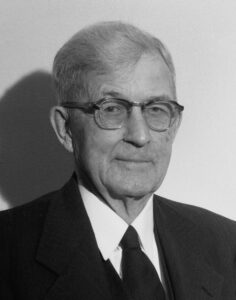 ocky soil, insufficient water, collapsed land booms — Dodd refused to quit. In 1916 he organized the Lower Umatilla Association to push for McKay Dam, eventually securing a $3 million appropriation that led to the dam’s construction and the opening of 10,000 acres of farmland in 1928.
His most consequential fight was for McNary Dam. Beginning with a speech in 1925, he spent decades lobbying, organizing, and campaigning — even running for governor in 1934 partly to publicize the cause. He founded the Tri-State Development League, traveling through 18 counties across Oregon, Washington, and Idaho to build support. Work on the dam finally began in 1947, and President Eisenhower dedicated it in 1954, with Dodd seated on the platform.
Beyond irrigation, Dodd served in the Oregon Legislature, sat on the Hermiston City Council, served as Justice of the Peace for 20 years, and was named First Citizen of Hermiston in 1950. He also compiled decades of scrapbooks documenting the region’s history, copies of which were donated to libraries and institutions across the state.
He died in 1959 at age 89 — having lived long enough to see nearly every dream he fought for come true.