
Carnegie Building Beginnings
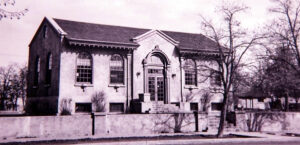
Hermiston was one of 31 Oregon communities to receive a Carnegie Library built with money donated by Scottish-American businessman and philanthropist Andrew Carnegie. In all, 1,689 public Carnegie Libraries were built in the U.S. between 1886 and 1929.
Carnegie required public support rather than making endowments because, “An endowed institution is liable to become the prey of a clique. The public ceases to take interest in it, or, rather, never acquires interest in it.”
Carnegie (1835-1919) was a Scottish-American industrialist who devoted the last third of his life to giving away the bulk of his fortune, one of the greatest in the United States at that time. As a boy growing up in a working-class immigrant family in Allegheny (now part of Pittsburgh), Pennsylvania, he was able to use a small library established by Col. James Anderson for workers in the poor, industrial community. Carnegie later said of the experience: “I resolved if ever wealth came to me, that it should be used to establish free libraries, that other poor boys might receive opportunities for which we are indebted to that noble man.”
In order to obtain a grant for a Carnegie library, a community had to meet certain conditions. It had to demonstrate the need for a library, provide a site, and, most importantly, create a “maintenance fund” to operate the library that was at least equal to 10 percent of the building cost. In order to come up with a maintenance fund, most communities had to establish a tax-supported library, many for the first time.
This was the case in Oregon at the turn of 20th Century, where there were no tax-supported public libraries.
Like many ambitious young architects of his generation, Folger Johnson (1882 – 1970) arrived in Portland in the early 20th Century as the booming city emerged as the major metropolis of the Pacific Northwest. Born in Georgia, Johnson received his architectural education at Columbia University in New York and later at L’Ecole des Beaux Arts in Paris.
After arriving in Portland in 1911, Johnson partnered with several significant Portland architects during a 50-year architectural career. Johnson received many public and private commissions including Carnegie libraries in Portland and as far away as Eastern Oregon. His buildings show a command of the classical architectural vocabulary as well as a satisfying flavor of the modernist elements popular in the first three decades of the twentieth century.
Nearly a dozen of his designs are now listed on the National Register of Historic Places. Johnson’s career in Portland included his work on the Town Club in the King’s Hill Historic District – one of Johnson’s best-known designs.
Johnson was lead architect for seven Carnegie libraries in Oregon, three of which are on the National Register: the Tudor-influenced Gresham Library (1913), the Italian Renaissance Revival-style Umatilla County Library in Pendleton (from 1916), and the Colonial Revival Arleta Library, renamed the Wikman Building, in southeast Portland (1918). His other Carnegie designs are the branch library in St. Johns, the South Portland library in the Lair Hill neighborhood, the Rose City Park Library, and the library in Hermiston.
Although the Carnegie Building wasn’t Hermiston’s original library location, it served as the city’s library for 70 years – 1919 to 1989.
The Hermiston Public Library officially opened on May 16, 1914 in the brick building at the corner of East Main and Northeast Second Street (the longtime RoeMark’s Building.) It moved one block north into the newly constructed Carnegie Building in 1919 (which is now used as Hermiston city offices) and moved again in the 1980s into a new library building next door.
In 1914, Hermiston met all of the requirements except one: The town’s population of barely 1,000 didn’t demonstrate sufficient need for a library. A local woman identified in the record as “Miss Prann” came up with a solution that satisfied Carnegie: Call it a branch of the Pendleton Library.
While Prann only served a year, her tenure was 12 times longer than the second librarian. In 1915, C.D. Porter, the librarian’s janitor, was asked to serve as its librarian, as well. One month later, he had enough and went back to strictly janitorial work.
Of 13 librarians as of 2024, the longest serving librarian was Irene Bronson, who served from 1921 to 1946. Ruth Woodard and MLou Williams had the second-longest tenures at 20 years each.
At the library’s 100th anniversary celebration in May 2014, the rarest artifact on display Friday was the only remaining book from the library’s initial collection, Princess Flower Hat by Mabel Osgood Wright.
Sources: oregonencyclopedia.org, Architectural Heritage Center, East Oregonian, Northeast Oregon Now.