
Hermiston’s Onion Empire
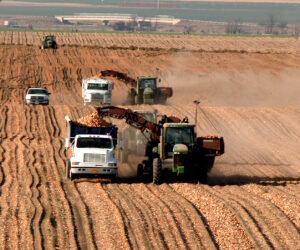
The watermelon may be the official symbol of Hermiston, but the onion also deserves its place at the Northeast Oregon dinner table.
Before they’re sliced, diced, battered or crunched, onions are grown commercially in more than 20 states. According to the National Onion Association, U.S. farmers plant about 125,000 acres of onions each year, and 20 percent of those hit the soil in Idaho and Eastern Oregon. The region produces about 1.47 billion pounds of onions annually.
While the Treasure Valley along the Oregon-Idaho border stakes its claim to the bulk of those acres, Umatilla County also has a piece of the onion empire: Hermiston-based River Point Farms is the largest commercial onion company in the nation.
“We’re about two times larger than our nearest competitor,” owner Bob Hale said. “We have about 520 employees and sent out 1,450 W-2s last year. People are usually surprised by the size and scale of our operation.”
River Point Farms rotates its onion crops through 32,000 acres in the Pacific Northwest, including a 45-mile strip of Umatilla and Morrow counties from Boardman to Pendleton. About 85 percent of the company’s onions are grown in the two counties, and River Point Farms ships 180 semi-trucks full of onions a week nationwide – 52 weeks a year.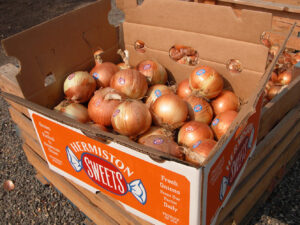
River Point Farms harvests its onions from June to November. A whole onion has a shelf-life of 21 days; cut onions only last 14. Because of that change, temperature-controlled storage facilities play an important role in allowing for transportation and processing of onions year-round. River Point Farms stores about 300 million pounds of onions per year.
“You want to keep the onion as fresh as the day it was harvested,” Hale said.
In Umatilla County, onions fall into two primary categories: sweet onions and storage onions, according to Phil Hamm, director of Oregon State University’s Hermiston Agricultural Research and Extension Center.
“It’s a great rotational crop, value-added,” Hamm said.” A lot of people are employed by onions.”
Onions now have an important place in Northeast Oregon’s agricultural scene, but the crop hasn’t always been a regional success story: Early growers struggled with the region’s sandy soil and high winds; sand would blow across the crop, severing the top and killing the plant.
In the 1980s, River Point Farms began testing a new method for onion production to protect against the destructive winds: planting onions in between rows of wheat. The grain grew taller than the onions, protecting them from the wind.
“It doesn’t get any better for onions than sandy soil, as long as you can control wind erosion,” Hale said. “That made the difference.”
The wheat technique resulted in the almost exponential growth of River Point Farms; with wind erosion under control, onions could take advantage of the region’s other benefits.
Hamm said onions, like many crops, thrive in the Columbia Basin because of five main factors:
- Well drained soil
- Columbia River water that is pure of dissolved materials, such as salt
- Long growing season
- High light intensity
- Warm days and cold night
“In other places, like California and Arizona, it may be equal temperatures during the day but they’ll only cool down to 80s. Here’s it’s not uncommon to cool down to 60s or even lower. That’s great for crops because the net gain is more carbohydrates, more starch, which break down into more sugar,” he said.
Higher sugar content leads to greater crop yields and high-quality produce. In addition to impacting onions, that net sugar gain is also what gives Hermiston watermelons their sweet taste and texture.
“There may be a few other places in the world as unique as ours, but not very many,” Hamm said.
For onions, the Pacific Northwest has a corner of the market.
About 21,000 acres of onions are planted each year in Idaho and Eastern Oregon, making the region second only to Washington, where growers plant an estimated 22,800 acres a year.
The National Onion Association puts California in third place, with about 17,850 acres planted each year; and Western Oregon comes in eighth, with just under 6,000 acres planted a year.
Those four regions also make up four out of the top five regions for volume in pounds of onions produced overall.
“Onions are a major crop, one of the big ones for the area,” Hamm said. “There’s a lot to be said for onions.”
From Ruralite, September 2013